Got a bit of my initial investment funds back. Sold two under-seat gas tanks, both hoods I didn't want, and three shot fenders, all for $120. I could've gotten more, but getting them all gone in one transaction was worth it. Add to that the early Bronco Dana 20 I bought for $60 and sold for $90, and I'm doing alright on the budget.
A few more parts to go, including the yellow grill and the CJ5 white spoke rims.
Wherein I document my build-up and use of a Jeep CJ-X for off-roading with my family.
Monday, September 9, 2013
Sunday, September 8, 2013
Bumper dumping time
I had backed the Willys into the garage when I first brought it home so that when I'm ready to get the motor running, I'll be able to do so easily. Unfortunately, that placed the hideous mega-bumper towards the inside of the house, which urged in me some extra caution today as I had at it.
Of course, the original owner had welded the entire beast in place--no bolts here. Prior to my purchase, Charlie had started the excision, cutting some holes in the steel diamond plate (no wimpy aluminum here), which gave me a good sense of how to go about removing this thing: in pieces.
There were three main structural beams under the plating, two vertically-aligned beams of 3/8"x3" steel on the outer edges of the step/bumper and an inverted T-beam in the middle of the same thickness. They reached out to a second, beefier-than-stock C-channel bumper, garnished with a heavy hitch and a U-shaped rod as an attachment point.
I cut from underneath to weaken the structure, working my way through the bottom of the T-beam with the sawzall and the grinder, switching back and forth as needed. I hadn't worked with a grinder before, so I took my time, easing into it to avoid injury to myself or damage to the tool. I took out some of the diamond plate to get access to the right side beam from up top. I cut through it rather easily. To get better access to the center beam, I sliced down through the C-channel second bumper just to the right of the T-beam. I folded it down and finished it off.
Off to the left side to do the same. Remove a chunk of diamond plate. Grind/saw through the steel beam. Bend it to get better access to the T-beam. Cut away the last bit. Repeat.
My steel scrap pile is beginning to grow. I hope to get a bit of cash for all this stuff. Thirty cents a pound will start to add up, given that the bumper is at least fifty pounds, if not more. Between that and the shot body parts, I've got a hundred bucks worth of steel in the backyard.
All in all, this was a satisfying start to the body work. Upon completion, the original rear crossmember/bumper is now visible. Not surprisingly, it will need to have the last remnants of the structural beams cut off and/or ground down, followed by some grinding/sanding to clean it up. Then I will paint it to match the rest of the frame. It's all about returning this little rig to its former use and glory, stripping away or repairing the mistakes made in its previous life.
Next up, the sheet metal on the keeper tub. My idea du jour is to use bits of the shot tub to piece together the keeper. We'll see.
Sunday, September 1, 2013
Assessing what I have
My new rig is an absolute basket case that was destined either for a mercy killing or a parting out on Craigslist. But the previous owner, Charlie, had a sentimental attachment to it and couldn't handle the idea of parting it out. He had driven it in high school while working for the original owner on that guy's farm up in Visalia and had hoped to restore it after the original owner passed away. But he ran into a problem. He's 6'6" and 275. So he had to let it go, but he wanted it to go to a good owner that would put it back together and enjoy it, which I will indeed do with Kim and the kids.
I'm taking up the cause of resurrection, but it's too far gone to be a beauty queen. It's a 1951 CJ3A, serial number 451-GB1 37063. But I got a whole lot more than I need.
My parts haul:
* The frame is strong. I've been under and around it looking for cracks and I'm quite happy so far. Charlie was constructing some 3" body lift blocks, but I'll be dropping it down to stock height with new stock urethane body mounts. As I said before, I want this to have minimal lift with the 32s. I may have to go with a 1" body lift, but we'll see.
* Stock axles are in good shape with 11" rotors front and rear.
* Two tubs--the other is a CJ2A (i think based on the top mounting points on the outside of the tub) that is just a few hat channels from becoming Fred Flintsone's four wheeler.
* Two window frames, both from CJ2As. One looks quite good. The other has some extra metal pieces welded on it (accommodate theme among my parts cache). I like the fold out window feature of the 2A, so this was a welcome surprise.
* Five fenders, one set matching the CJ2A tub, one pair from another rig entirely, and one that matches the CJ3A.
* Three hoods--from the same three rigs as the fenders. One of them weighs an absolute ton because someone in its past gave it a second skin on its underside. This is the good one.
* Three grilles, one with nice headlight bezels and blinkers that came from the CJ2A tub.
* Three gas tanks--two stock and one that fits above the rear axle.
* Speaking of which, it came with a Ford Windsor 260 V8 (I wish it was a 289). The shade tree welder who "installed" the mounts made them beefy enough, but I'm not sure I like how boogered up they are.
* Massive leaf springs front (9 leaves) and rear (13 leaves--military?). They look like the ones I've seen on a M38A1 I was considering. I'm concerned they will make it ride like the rear axle is bolted to the frame directly. I may have to ditch them for a 2.5-3" Rancho lift kit.
* In front of that, I've got a T90 that I might open and and look at, paying close attention to the second gear syncros. Look at all those lovely shifters, two for the Dana 18, one for the Warn, one for the T90.
* Front and rear seats. Don't think the rear is stock, but it fits between the fender wells.
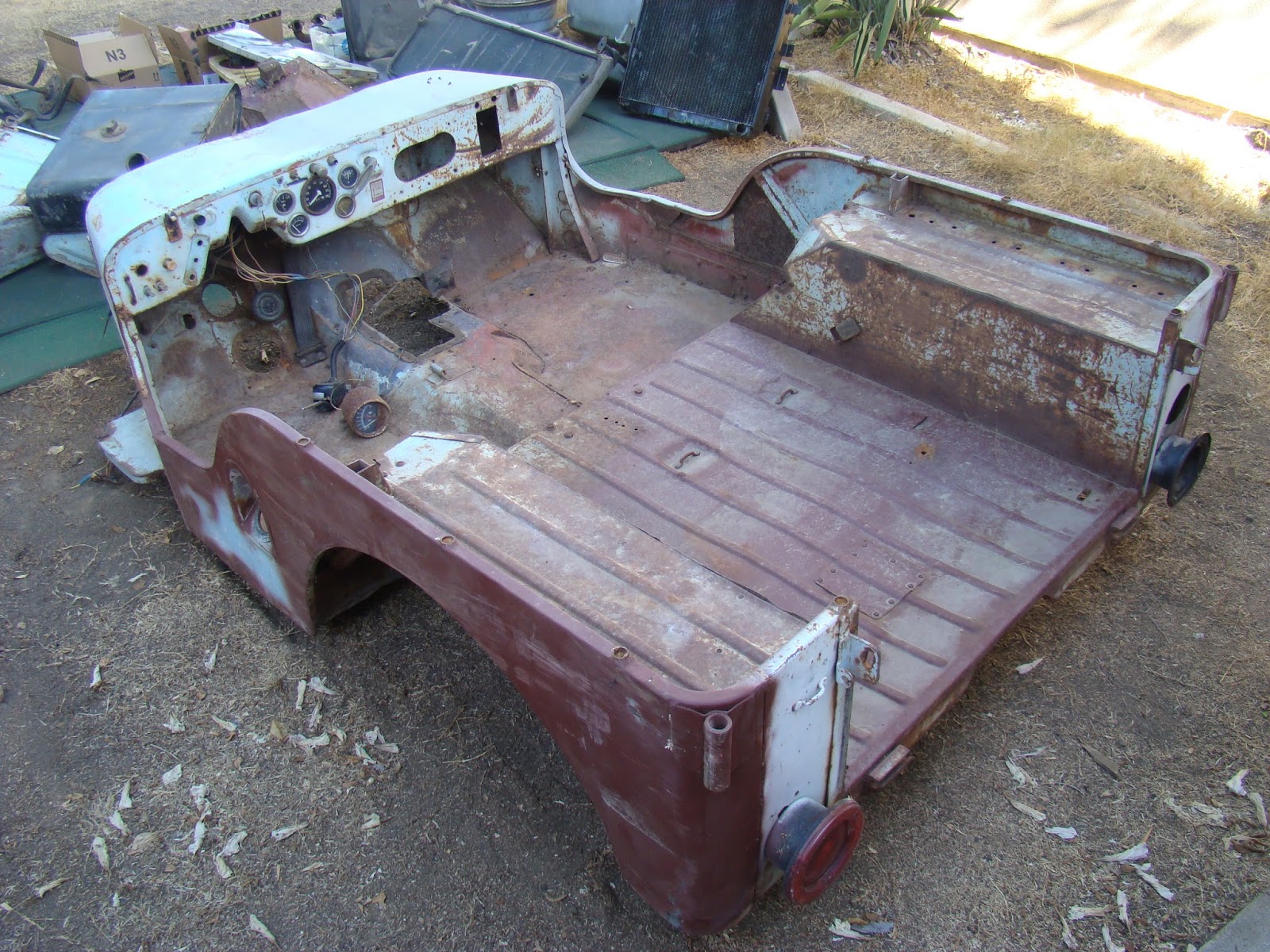
* The CJ3A tub is hacked in a few areas. First, the tool box under the passenger seat is gone, with new metal stitched in (see tub shot above).
Second, parts of the rear fender wells were cut out to accommodate, of all things, a bench seat in the front. The original owner had some creative ideas when it came to welding--not sure if any of them were good ideas, though.
* Beat up tailgate. The 2A tub had a thick sheet of steel welded across its back. I want the tailgate.
All in all, it's going to give me ample opportunity to learn the fundamentals of metal working: cutting, grinding, welding, shaping, and so on.
I know some aren't fans of making these classic rigs into wheelers, but that's why I found a rough one (well, a rough pair) that would never qualify for a restoration. It would cost less just to buy all new parts than to fix this thing and make it look good.
In the end, the front half will be a CJ2A, the tub and below a CJ3A, moved along by one of the whimpier Ford V8s out there that will still be way more powerful than the stock four cylinder.
It'll never be done, but it will always be fun.
Saturday, August 31, 2013
Bought it and dragged it home
So there's this article in the March 2010 issue of JP Magazine that gives advice on how to score a vintage project. It's my bible, but for a while it was more a fantasy. Here's what Christian Hazel advised:
1. Have a trailer and tow rig ready to go. It's helpful if you have a winch on your trailer or at least have a Hi-Lift jack you can use to help you load a non-running vehicle. If it's down to you and your trailer or another potential buyer with no way of removing the project Jeep, guess who the owner is going to cut the better deal?
2. If you don't have a trailer, make sure your AAA or other towing membership is in good order and the company you're hiring can pick up your new purchase for you.
3. If you're serious about buying, keep your cash handy. Hide it in your house or somewhere safe in case that killer deal pops up when the banks are closed. Having your cash at hand also helps ensure you're the first one to the prize.
4. Bring along a compressor or Powertank to air up flat tires, a selection of hand tools, some lube spray, and whatever else you may need to loosen seized brake shoes, reaffix steering components, or inflate flat tires so you can move and/or drive your new pile away.
5. Be flexible. This can mean anything from meeting the seller after their 2nd shift job lets them off work after midnight or being willing to take away extra junk parts. However, more often than not it means conceding certain parts of sentimental value that the seller may not want to let go of, such as vanity plates, shift knobs, or even seats, wheels, or other trinkets.
1. Well, I didn't have a trailer, but I did have UHaul. I hate using them for anything but the most desperate of circumstances. I could have driven up and back in the Big Jeep, but that would have cost a few pennies in gas and I wouldn't have been able to bring back all of my loot, just the rig flat-towed and what parts would fit in the back. So I reserved a Uhaul 14 footer and auto trailer for the Little Jeep and its extra pieces, which I knew would be numerous. Charlie (the second owner who sold it to me) was able to arrange for a few of his kin to help out. They were great people. Friendly, helpful, and funny.
2. N/A.
3. I had gotten cash out to purchase an M38A1 in Rialto that was the classical example of the "good from afar but far from good" cliche. It was slathered with olive drab house over diamond plate, a Ford 200 Inline Six, and a large gas tank for a back seat. No sale. But I kept the cash out (at my wife's suggestion) to keep handy for when the real purchase would be coming.
4. I was loaded with most of these tools, but I didn't need any of them. I did bring extra axle straps to hold the rig down on the auto trailer. I used one to hold the body tub more securely to the frame. I used one to latch down the front axle to the trailer tongue, and another to firm up the rear axle to keep it from bouncing (much). (Apparently as Kim followed me south on the way home, she saw the trailer itself catch air on a few dips, as well as possibly the body and/or rear axle.)
5. I was happy to being flexible, but the truly flexible individuals were my wife and kids who enjoy--and simultaneously tolerate--this Jeep thing from which I suffer. The window of opportunity was right for us to go get this thing. This was the last weekend without soccer games until Thanksgiving, it was a four-day weekend for me without grading, and Charlie's asking price was at my price point, no haggling required. I kept in contact with Charlie for over the course of the week after we struck our deal. He wanted someone who would rebuild this thing rather than part it out, and I wanted something I could piece together/resurrect.
Charlie had kept the Jeep pieces in a side/rear lot of sorts that had a fifth wheel RV trailer in it, as well. The parts were scattered about. I think Charlie had kept it all in there since 2005 when he took ownership from the original owner for whom he had worked (and driven the 3A) since high school.
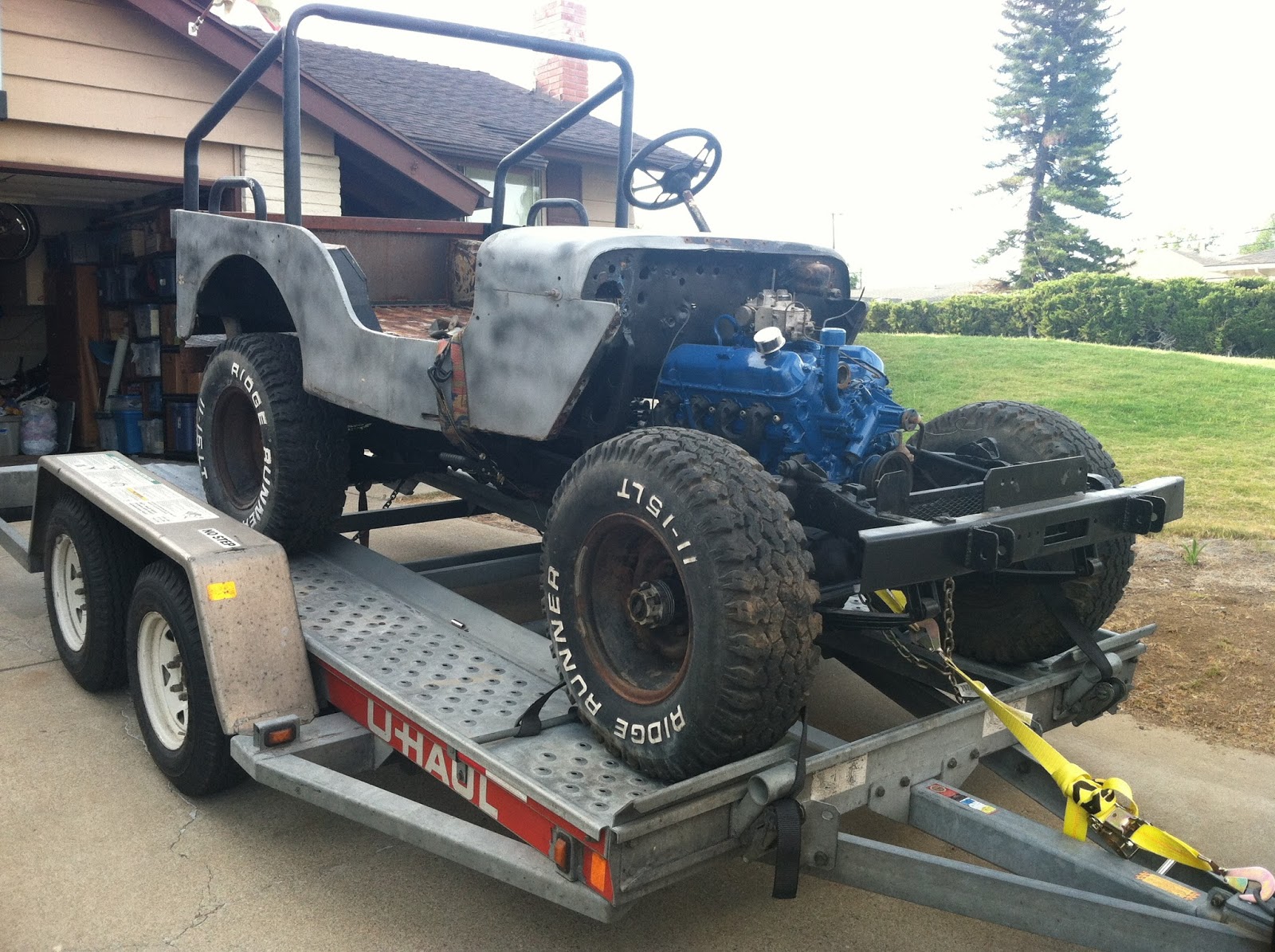
Unloading was interesting, to say the least. I'd never towed a trailer before, and I certainly had little skill at reversing. I actually looked up UHaul's advice on trailer driving the morning of our trip up to the Central Valley. I read the reversing section twice, and it didn't help much. Of the entire hauling/trailering experience, getting the CJ3A off the trailer and in the garage was my biggest preoccupation. Would Kim and I be able to push the Jeep up off the trailer? Would we need to get the kids to help? With no functioning steering linkage, would it have a mind of its own?
Draft one, which left the truck in the street in its entirety and the trailer on the steeper part of the driveway.
After a bit of wiggling that reminded me of that great scene in Austin Powers when he tries to U-turn the golf cart, I got it up the driveway in such a way that I wasn't even blocking traffic. But it was still slopped towards the truck and not the garage. I would overcome.
I had to get it over the steel bars that held the front tie-down straps to the trailer (you can see one of them in the above pick just behind the passenger side front wheel). My system, which worked well, was to use two heavy duty ratchet straps. I'd crank on one to pull the Jeep uphill. Once it was fairly maxed out in terms of the amount of strap looped on the ratchet itself, I'd stop, switch to the other one, and repeat. Through this alone, I was able to move it uphill about four feet, enough to give me and Kim room to push it that last bit. It balanced well with the rear wheels on the ramp and the front on the trailer. Then came the messy part.
My plan didn't allow me to have much of a way to stop the Jeep once it started its way into the garage. We moved everything back and to the sides, but the Jeep wasn't aimed quite right. It rolled hard and pulled me with it; I slipped on the dusty garage floor, slammed my right knee/quad into the left tow-bar bracket, and landed on my ass. I'd like to think that I slowed the rolling chassis down a little, but I'm probably delusional (or attempting to justifying the pain I felt and still feel just a titch).
Like a glove, with room to spare. I did have to move my unicycle, which kept getting caught on the roll bar as Kim and I moved the Jeep forward and backward, turning the wheels by hand (no steering linkage yet, remember). If you look in the above pic, the Jeep initial rolled straight back into the green dolly and wood pile. It was a thud and a half, but we got the job done, and nobody else got hurt.
Next we had to get all the parts out of the truck itself, including a full tub. The kids, Kim, and I did the unloading. Sorry, no pics of the kids. They grabbed headlight bezels, exhaust manifolds, grilles, seats, CJ5 rims, fenders, and more. Studs, all. Once it was tub time, they cleared out. The eldest took the camera, and Kim and I went to it. We used an old piano dolly I made in 2003 to get a piano out of our Irvine apartment and into our first house. If you could have possibly doubted Kim's commitment to me and this crazy project, look at the next few pics. She's simply unreal.
We pivoted it around a few times rather than slide it. But when we got close to the gate, we had to slide it.
We put it on the whiteboard material I use when working under the Big Jeep (which used to be our weekly calendar in the dining room). Its slick surface allowed for a smooth shift. Then we just muscled it the rest of the way home.
2. N/A.
3. I had gotten cash out to purchase an M38A1 in Rialto that was the classical example of the "good from afar but far from good" cliche. It was slathered with olive drab house over diamond plate, a Ford 200 Inline Six, and a large gas tank for a back seat. No sale. But I kept the cash out (at my wife's suggestion) to keep handy for when the real purchase would be coming.
4. I was loaded with most of these tools, but I didn't need any of them. I did bring extra axle straps to hold the rig down on the auto trailer. I used one to hold the body tub more securely to the frame. I used one to latch down the front axle to the trailer tongue, and another to firm up the rear axle to keep it from bouncing (much). (Apparently as Kim followed me south on the way home, she saw the trailer itself catch air on a few dips, as well as possibly the body and/or rear axle.)
5. I was happy to being flexible, but the truly flexible individuals were my wife and kids who enjoy--and simultaneously tolerate--this Jeep thing from which I suffer. The window of opportunity was right for us to go get this thing. This was the last weekend without soccer games until Thanksgiving, it was a four-day weekend for me without grading, and Charlie's asking price was at my price point, no haggling required. I kept in contact with Charlie for over the course of the week after we struck our deal. He wanted someone who would rebuild this thing rather than part it out, and I wanted something I could piece together/resurrect.
Charlie had kept the Jeep pieces in a side/rear lot of sorts that had a fifth wheel RV trailer in it, as well. The parts were scattered about. I think Charlie had kept it all in there since 2005 when he took ownership from the original owner for whom he had worked (and driven the 3A) since high school.
Unloading was interesting, to say the least. I'd never towed a trailer before, and I certainly had little skill at reversing. I actually looked up UHaul's advice on trailer driving the morning of our trip up to the Central Valley. I read the reversing section twice, and it didn't help much. Of the entire hauling/trailering experience, getting the CJ3A off the trailer and in the garage was my biggest preoccupation. Would Kim and I be able to push the Jeep up off the trailer? Would we need to get the kids to help? With no functioning steering linkage, would it have a mind of its own?
Draft one, which left the truck in the street in its entirety and the trailer on the steeper part of the driveway.
After a bit of wiggling that reminded me of that great scene in Austin Powers when he tries to U-turn the golf cart, I got it up the driveway in such a way that I wasn't even blocking traffic. But it was still slopped towards the truck and not the garage. I would overcome.
I had to get it over the steel bars that held the front tie-down straps to the trailer (you can see one of them in the above pick just behind the passenger side front wheel). My system, which worked well, was to use two heavy duty ratchet straps. I'd crank on one to pull the Jeep uphill. Once it was fairly maxed out in terms of the amount of strap looped on the ratchet itself, I'd stop, switch to the other one, and repeat. Through this alone, I was able to move it uphill about four feet, enough to give me and Kim room to push it that last bit. It balanced well with the rear wheels on the ramp and the front on the trailer. Then came the messy part.
My plan didn't allow me to have much of a way to stop the Jeep once it started its way into the garage. We moved everything back and to the sides, but the Jeep wasn't aimed quite right. It rolled hard and pulled me with it; I slipped on the dusty garage floor, slammed my right knee/quad into the left tow-bar bracket, and landed on my ass. I'd like to think that I slowed the rolling chassis down a little, but I'm probably delusional (or attempting to justifying the pain I felt and still feel just a titch).
Like a glove, with room to spare. I did have to move my unicycle, which kept getting caught on the roll bar as Kim and I moved the Jeep forward and backward, turning the wheels by hand (no steering linkage yet, remember). If you look in the above pic, the Jeep initial rolled straight back into the green dolly and wood pile. It was a thud and a half, but we got the job done, and nobody else got hurt.
Next we had to get all the parts out of the truck itself, including a full tub. The kids, Kim, and I did the unloading. Sorry, no pics of the kids. They grabbed headlight bezels, exhaust manifolds, grilles, seats, CJ5 rims, fenders, and more. Studs, all. Once it was tub time, they cleared out. The eldest took the camera, and Kim and I went to it. We used an old piano dolly I made in 2003 to get a piano out of our Irvine apartment and into our first house. If you could have possibly doubted Kim's commitment to me and this crazy project, look at the next few pics. She's simply unreal.
We pivoted it around a few times rather than slide it. But when we got close to the gate, we had to slide it.
We put it on the whiteboard material I use when working under the Big Jeep (which used to be our weekly calendar in the dining room). Its slick surface allowed for a smooth shift. Then we just muscled it the rest of the way home.
Here's the stash. I'll more precisely inventory it in another post.
Subscribe to:
Posts (Atom)